
From real-time video generation and 3D asset creation to personalised visual AI and the death of the stock photo industry — here is what is coming, when it is coming, and how to prepare your team and creative workflow for what is next.
🔍 QUICK ANSWER — What is the future of AI image generation? The next five years in AI image generation will be defined by five major shifts: (1) real-time and video generation replacing static images as the default, (2) agentic AI platforms automating entire creative campaigns from a single brief, (3) personalised brand visual systems that maintain identity automatically at scale, (4) 3D and spatial content for AR/XR becoming mainstream creative output, and (5) new professional roles emerging around AI creative direction. Static prompt-and-generate workflows will be the baseline by 2027 — the competitive edge will belong to teams that have built systematic AI-integrated creative processes ahead of the curve. |
Where We Are Right Now — The 2026 Baseline
Before looking forward, it helps to understand exactly how far this technology has come in a remarkably short time. In early 2022, AI image generation was a novelty producing uncanny, artifact-riddled outputs that were clearly distinguishable from human-made images. By February 2026, the tools in this series — DALL-E 3, Nano Banana 2, Seedream, Ideogram, and Agent-Pix-It — produce outputs that are:
Photorealistic at 4K resolution in under 2 seconds (Seedream)
Grounded in real-world knowledge and current events (Nano Banana 2)
Reliably accurate for readable text inside images (Ideogram)
Coordinated across entire campaign briefs by AI agents (Agent-Pix-It)
Indistinguishable from professional photography for most marketing use cases
The pace of improvement from 2022 to 2026 was faster than almost anyone predicted. The pace from 2026 to 2030 is projected to be faster still — driven by architectural improvements, multimodal integration, and massive increases in training data quality and scale.
📊 Speed of Progress Context: In 2022, generating a single 512×512 image took 30–60 seconds on consumer hardware. In 2026, generating a 4K image takes under 2 seconds in the cloud. Resolution has increased 64x. Speed has increased 15–30x. Quality has improved by orders of magnitude. The next 4 years will see equivalent or greater improvements in video, 3D, and interactivity. |
The Technology Roadmap — What Is Coming and When
Here is how the major capabilities are expected to develop across the next four years, based on current research trajectories, announced development roadmaps, and emerging capabilities visible in early 2026:
Period | Already Here / Near | Emerging (12–24 months) | Horizon (2–5 years) |
2024–2025 | Photorealistic image generation, basic video clips, text rendering improves | Real-time generation, multimodal prompting begins | Native 4K video, agent-led creative workflows |
2026 | Agentic image platforms (Agent-Pix-It), 4K native generation, real-world grounding | Real-time video generation, 3D asset generation, live brand consistency engines | Personalised visual AI assistants, generative brand systems |
2027 | Agentic multi-image campaigns, video ads from text briefs | Real-time interactive 3D, AI creative directors, generative product design | AI-native advertising ecosystems, fully automated visual content pipelines |
2028–2030 | Ubiquitous AI visual content across all media | Physical-digital integration (AR/XR), personalised visual experiences at scale | AI co-creator roles normalised, new creative professions emerge |
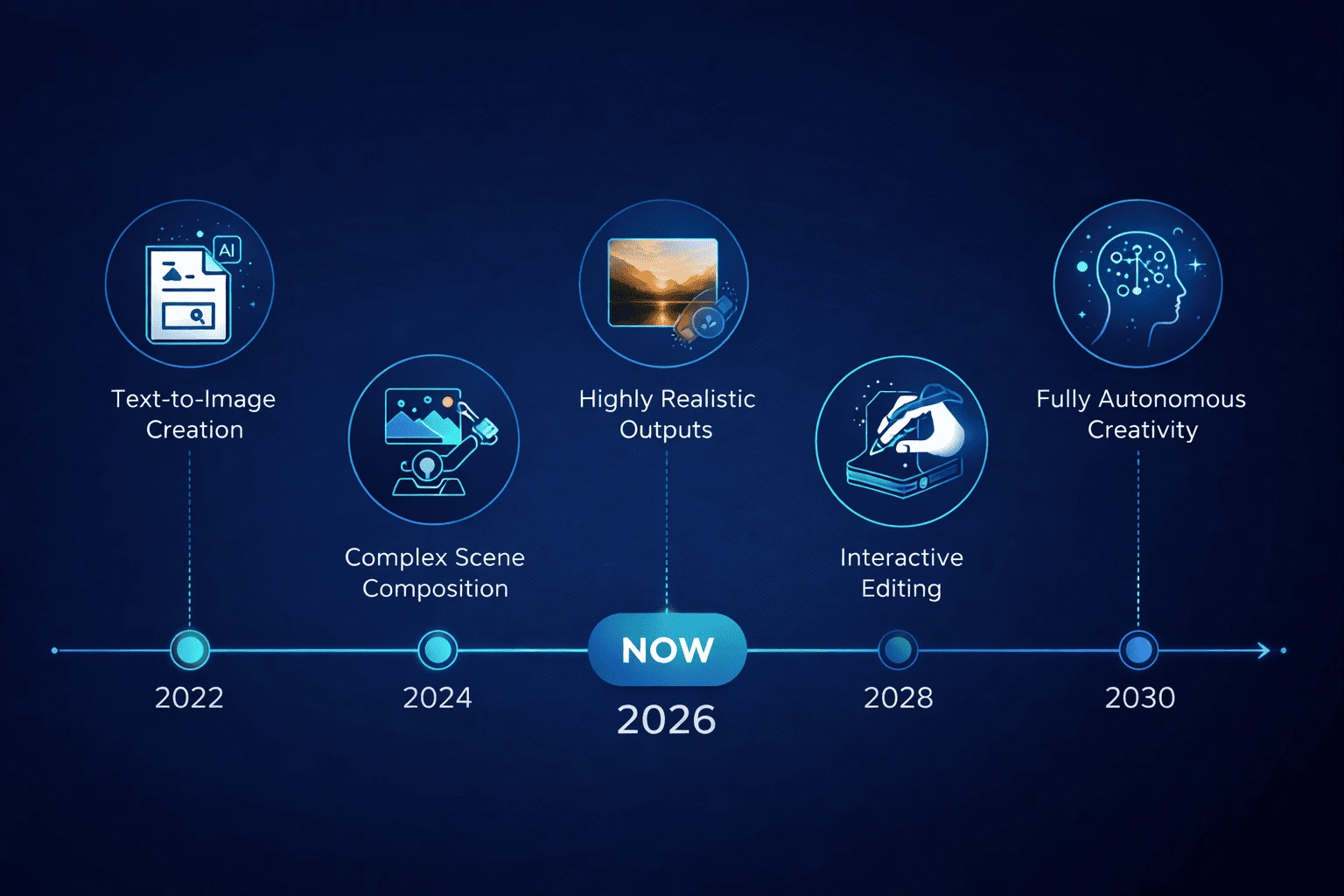
10 Trends Shaping the Next 5 Years
🎬 01 | Real-Time and Video Generation Becomes the Default Static images are the beginning — motion is the destination The shift from static image generation to video and real-time animation is already underway in 2026. Tools like Sora (OpenAI), Runway Gen-3, and Kling (Kuaishou) can generate 5–30 second video clips from text prompts. By 2027–2028, generating a 30-second social media video from a brief will be as fast and simple as generating a static image is today. For marketing teams, this means the entire concept of a 'content asset' is changing — from static images to short-form motion, looping animations, and interactive visual experiences generated on demand. |
🤖 02 | Agentic Creative Platforms Replace Manual Workflows Brief once. Get a campaign. Done. The most significant near-term shift for marketing teams is not better image quality — it is the move from single-image generation to agentic campaign production. Agent-Pix-It represents the early version of this shift: a platform that takes a creative brief and orchestrates multiple generation steps, model selections, quality checks, and output variants automatically. By 2027, this capability will extend to producing entire campaign suites — social posts, ad variants, email headers, video clips, and landing page visuals — from a single brief in a single workflow. The role of the human shifts from operator to director. |
🎨 03 | Personalised Brand Visual Systems Your brand's visual identity — maintained automatically at scale One of the most challenging problems in AI image generation for brands is consistency. When 50 people on a team use AI tools with different prompts, the resulting content looks inconsistent and off-brand. The next generation of tools will solve this with brand visual systems — persistent style configurations that encode your colour palette, composition preferences, photographic style, and mood parameters. Every team member generates on-brand content automatically, without needing to specify brand parameters in every prompt. Agent-Pix-It is building toward this model — and it will become a standard feature across enterprise creative tools by 2027. |
🧊 04 | 3D Asset and Spatial Content Generation The next frontier after 2D images As AR glasses, spatial computing devices, and immersive environments become more mainstream, the demand for 3D visual assets will surge. Research teams at major AI labs are already generating textured 3D models from text prompts and 2D images. By 2027–2028, generating a 3D product model from a text description — ready for use in AR try-on, spatial advertising, or interactive product pages — will be a standard capability. For e-commerce, retail, and product brands, this is one of the most significant upcoming shifts: 3D product visuals on demand, without a 3D modelling studio. |
🎤 05 | Multimodal Prompting — Image + Voice + Sketch Describing what you want any way that is natural Current prompting is primarily text-based. The next generation of tools will accept multimodal inputs — you will be able to rough-sketch a composition, speak your style preferences, upload reference images, and type a brief all in the same interaction. The AI will synthesise all these inputs into a single generation instruction. This removes the primary barrier for non-designers: the requirement to articulate visual concepts in precise written language. Nano Banana 2's Gemini integration already hints at this direction — and it will be the norm by 2027. |
🌐 06 | Real-World Grounding Becomes Universal AI that knows what is happening in the world right now Nano Banana 2's real-time web grounding is currently a differentiator — but it will become a baseline capability across all major tools. Models will be able to generate images that are accurate to current events, trending visual styles, real product specifications, and real-world locations — not just patterns learned from historical training data. For news publishers, event marketing, and trend-responsive brands, this transforms AI image generation from a creative tool into a visual journalism tool. |
👤 07 | Hyper-Personalisation at the Individual Level One image. Tailored to every viewer. Today, AI generates one image for all viewers. The emerging capability is generating personalised visual content for each individual at the moment they encounter it. An email campaign might show each recipient a product lifestyle image tailored to their location, season, and past behaviour. A website hero image might adapt in real time to the viewer's demographic profile. This level of personalisation was previously impossible at scale — AI generation makes it a near-term reality. Early implementations are already live in 2026; scale and quality will improve dramatically by 2028. |
🔐 08 | C2PA and Provenance Standards Become Infrastructure You will know if an image is AI-generated — automatically The Coalition for Content Provenance and Authenticity (C2PA) is developing a technical standard for embedding verifiable provenance data into image files — recording how an image was created, by whom, and with what tools. Adobe, Microsoft, Google, and OpenAI are all signatories. By 2027–2028, most major platforms will require or display C2PA provenance data, making AI generation transparent by default. For brands and publishers, this changes disclosure from a policy question to a technical infrastructure question — it will happen automatically. |
📉 09 | The Stock Photo Industry Continues Its Structural Decline A $4 billion industry facing its most disruptive decade Stock photography agencies faced their first major disruption from smartphones and citizen photography. AI image generation is a far more fundamental structural challenge. When any marketing team can generate a photorealistic lifestyle image in 2 seconds for near-zero cost, the use case for purchasing licensed stock images — waiting, browsing, paying per image — collapses rapidly. Getty Images, Shutterstock, and Adobe Stock have all begun integrating AI generation as a response. The industry will survive in specialised niches (authentic photojournalism, licensed celebrity content, legally-cleared real people) but the commodity stock market is structurally disrupted. |
🚀 10 | New Creative Professions Emerge Around AI Direction The tools change. Human creative judgment becomes more valuable. The most important trend is also the most counter-intuitive: as AI becomes better at execution, human creative judgment, strategy, and direction become more valuable — not less. The emerging high-value roles are not prompt writers but AI Creative Directors, Visual AI Strategists, and Generative Brand Architects — people who understand both the creative and technical dimensions of AI visual systems deeply enough to direct them toward meaningful outcomes. The tools get easier. The bar for using them strategically and distinctively gets higher. The people who invest in that knowledge now will have a significant advantage. |
What This Means for Creative Jobs and Teams
The honest answer to the question 'will AI replace creative jobs?' is: it depends entirely on the job, the professional's response, and the timeline. Here is a grounded assessment of how specific roles are affected:
Role | AI Impact | Why | Where It Goes |
Stock photographer | 🔴 High disruption | AI can generate infinite stock-quality images on demand at near-zero cost | Shift to specialised, authentic, or licensed real photography; AI consultant roles |
Junior graphic designer | 🟡 Significant change | Routine asset creation automatable — but design thinking, brand strategy not | Upskill to AI prompt direction, brand systems, creative strategy |
UI/UX designer | 🟡 Moderate change | Mockup generation faster, but user research and systems thinking irreplaceable | Incorporate AI into workflow; faster prototyping, more time for strategy |
Marketing art director | 🟢 Augmented role | AI handles execution; human oversees brief, brand, quality, and creative direction | New title emerging: AI Creative Director — highest-value role in the chain |
Copywriter | 🟢 Mostly augmented | Image generation requires strong briefing skills — written creative thinking needed more | Expand into multimodal creative direction; prompt engineering expertise valuable |
Brand identity designer | 🟢 Low disruption | Brand systems, strategy, and identity require deep human insight AI cannot replicate | Becoming more valuable as brands need to stand out in an AI-saturated landscape |
AI Prompt Engineer | 🚀 New role | Entirely new profession — translating creative intent into AI-optimised instructions | High demand across agencies, brands, and platforms — growing fast in 2026 |
AI Creative Technologist | 🚀 New role | Building and managing AI creative workflows, tool stacks, and agentic pipelines | Cross-discipline role combining creative, technical, and strategic skills |
💡 The Core Principle: AI is replacing creative execution. It is amplifying creative direction. The professionals who will thrive are those who move up the value chain — from 'making things' to 'deciding what things mean and why they matter.' That transition requires deliberate upskilling now, not when the disruption is fully visible. |
The Challenges the Industry Still Needs to Solve
Progress in AI image generation is not without significant unsolved problems. These are the challenges that will shape how the technology develops and what guardrails emerge:
Challenge | Why It Matters | Where Solutions Are Coming From |
Visual homogenisation | As everyone uses the same AI tools, visual culture risks becoming uniform and samey — creativity without differentiation | Tools with style customisation (Agent-Pix-It), human creative direction, and brand-specific fine-tuning will become the primary way to stand out |
Synthetic media trust crisis | Hyper-realistic AI images make it increasingly hard to distinguish authentic photography from fabrication | C2PA content provenance standards, platform watermarking, and AI disclosure requirements are being built into tools and platforms now |
Environmental impact | Large-scale image generation is computationally intensive — the energy footprint is non-trivial and growing | More efficient architectures (fewer steps, smaller models), green data centres, and per-generation energy disclosure are active research areas |
Bias and representation | Models trained on biased datasets reproduce and amplify those biases in outputs — affecting representation across race, gender, age, and culture | Active debiasing research, diverse training data curation, and human review workflows are the current best practice |
Creator economy disruption | The supply of visual content will vastly exceed demand — commoditising much of what was previously skilled creative work | Premium creative work will shift toward strategy, direction, and emotional intelligence — skills AI cannot replicate |
Regulatory fragmentation | Different countries are moving at different speeds with incompatible frameworks — creating compliance complexity for global brands | Work with platforms that actively track regulatory requirements (commercial AI tools) and maintain proper documentation of your generation process |
What This Means Specifically for Marketing Teams
For marketers and social media managers using AI image tools today, these trends translate into five concrete strategic implications:
1. Content Volume Will No Longer Be a Constraint
The bottleneck in content marketing has always been production — creating enough high-quality visual content to feed every channel, campaign, and audience segment. AI image generation removes that constraint entirely. By 2027, the constraint shifts to creative strategy and distribution intelligence. Teams that continue investing the majority of their capacity in content production rather than content strategy will be at a structural disadvantage.
2. Brand Consistency Will Require Systematic AI Governance
As more team members use AI tools, maintaining brand consistency becomes a governance challenge rather than a design challenge. The solution is investing now in prompt libraries, brand AI configuration documents, and style anchor templates that ensure everyone generates on-brand content. Teams that build these systems in 2026 will be dramatically more consistent and efficient than those scrambling to build them in 2027 when the tools are even more powerful and more widely used.
3. Personalisation at Scale Becomes the New Standard
In three years, every major competitor will be able to generate campaign-quality visuals on demand. The differentiator will not be who can generate visuals — it will be who can generate the right visual for the right person at the right moment. Investing in understanding your audience segments deeply enough to personalise visual content is the strategic move that compounds over time as personalisation tools mature.
4. Video Fluency Needs to Start Now
The learning curve for AI video generation is steeper than for image generation today — but it is shortening rapidly. Teams that start experimenting with tools like Sora, Runway, and Kling now will be significantly ahead of competitors when AI video becomes as fast and accessible as AI images are in 2026. Even generating simple 5-second motion graphics for social media stories builds the prompt engineering intuition that translates directly to video.
5. Agentic Workflows Will Compound Your Productivity Advantage
Tools like Agent-Pix-It demonstrate the direction of the industry: brief-to-campaign automation where AI handles model selection, prompt engineering, quality evaluation, and iteration. Teams that adopt agentic workflows early build compounding advantages — more content, more consistent, in less time. The investment in learning brief-writing and creative direction skills pays dividends that grow as the underlying tools improve.
🎯 The 2026 Marketer's Mindset Shift: Stop thinking: 'How do I use AI to make images faster?' Start thinking: 'How do I build an AI-integrated visual content system that improves every month?' The first mindset is a productivity hack. The second is a competitive moat. |
Your 8-Step AI Image Readiness Checklist for 2026
Use this as your action plan for the next 90 days — the practical steps that will position your team to benefit from where this technology is going:
Action | Starting Point | |
☐ | Adopt one AI image tool and integrate it into your regular workflow — even imperfectly | Start with Nano Banana 2 (free) or Agent-Pix-It (full workflow) |
☐ | Learn the 8-layer prompt formula and apply it to your next 10 content pieces | Blog 5 in this series has templates ready to copy |
☐ | Establish a generation log — tool, date, prompt, plan level — for all commercial outputs | Simple spreadsheet; 5 minutes to set up, protects you legally |
☐ | Assign someone to monitor AI tool updates and platform policy changes quarterly | The landscape changes fast — passive monitoring is not enough |
☐ | Experiment with video generation tools — even basic 5-second clips for social | Sora, Runway, Kling — the learning curve is low, the upside is high |
☐ | Review your brand guidelines to include AI image style parameters | Colour palette, style, mood, composition rules — all expressible as prompt anchors |
☐ | Train your team on AI image tools — even non-designers benefit from prompt skills | A marketing manager who can prompt effectively is worth two junior designers for content volume |
☐ | Test Agent-Pix-It for your next multi-image campaign | Brief once, get campaign-ready variants — measure time saved vs. traditional workflow |
Frequently Asked Questions
Will AI image generation completely replace human photographers and designers?
Not completely — but it will profoundly reshape both professions. For commodity work (product shots on white backgrounds, generic lifestyle content, stock imagery), AI is already more cost-effective and faster than human production. For work that requires authentic human presence, emotional intelligence, creative strategy, and cultural nuance — editorial photography, brand identity, campaign direction — human expertise remains irreplaceable and in fact becomes more valuable as AI handles the execution layer. The professions will not disappear; they will transform.
How long before AI video is as good as AI images are today?
The trajectory suggests 2–3 years. AI video in early 2026 is roughly where AI image generation was in early 2023 — impressive demos, but inconsistent quality and limited duration. The same architectural improvements that drove image quality improvements (larger models, better training data, latent diffusion) are being applied to video. By 2028, generating a 30-second high-quality video from a text brief is expected to be routine for commercial tools.
Should my business be investing in AI image tools now or waiting?
The cost of waiting is already higher than the cost of adoption. Teams that start building AI image workflows in 2026 develop prompt engineering skills, brand configuration documents, and production processes that compound in value as the tools improve. Teams that wait until 2027 or 2028 will be starting from zero while competitors have 2 years of systematic capability built up. The tools are already good enough for most commercial use cases — the question is not whether to adopt, but how to adopt systematically.
What happens to stock photo agencies in the next 5 years?
The agencies that survive will be those that pivot to authentic content AI cannot replicate: real photojournalism, licensed celebrity and athlete content, verified authentic cultural imagery, and curated editorial archives. The commodity stock segment — generic lifestyle photography, product shots, business people shaking hands — is structurally disrupted. The major agencies have already begun integrating AI generation into their platforms as a defensive move, but the underlying economics of commodity stock have fundamentally changed.
What is C2PA and do I need to care about it?
The Coalition for Content Provenance and Authenticity (C2PA) is a technical standard that embeds cryptographically verifiable provenance data into image and video files — recording how content was created, by whom, and with what tools. You do not need to implement it yourself — the tools you use will handle this. What you need to know is that by 2027–2028, major platforms will likely display provenance badges on content, making AI generation transparent by default. Building a practice of honest AI disclosure now puts you ahead of a requirement that is coming regardless.
How should I think about AI image tools relative to my existing design team?
The most productive framing is augmentation, not replacement. AI tools extend your design team's capacity dramatically — they can generate more content, faster, enabling your designers to focus on high-judgment work: brand strategy, campaign concepts, art direction, and the creative decisions that require taste and cultural intelligence. The teams that thrive are those that deliberately redesign workflows so designers are directing and curating AI output rather than competing with it for the same tasks.
🎉 Series Complete — You Have Read All 7 Blogs You have now read the complete Kumba AI guide to text-to-image generation: how the technology works, how to use the best tools, how to write prompts that get results, the legal landscape, and where it is all going. The next step is doing — pick a tool, run your first campaign, and build the workflow. Agent-Pix-It is available at kumba.ai to help you get there faster. |
The Complete Kumba AI Blog Series
🏠 |
⚙️ |
⚔️ | Blog 3: DALL-E vs Nano Banana vs Seedream vs Ideogram vs Agent-Pix-It |
🤖 |
✍️ | Blog 5: Prompt Engineering for AI Images — Tips, Templates & Examples |
⚖️ |